
Long before talent challenges show up in dashboards and quarterly reports, leaders feel them.
They might notice that decisions are taking longer than they should, or that certain roles no longer fit neatly into an org chart. Intuitive leaders will feel the quiet strain of even their highest performers.
Many executives describe the same instinctive feeling: something in the talent landscape has shifted, even if it is difficult to define. It rarely presents as a single issue like hiring shortages or burnout. Instead, it appears as a convergence of issues that seem to collide all at once.
What’s changing fastest in organizations today isn’t one function or role. It’s how talent decisions around hiring, leadership, and workforce stability are intersecting in real time.
Leading Through Change Is Growing More Complex
Before we examine what is happening in the talent landscape, it’s important to understand what today’s leaders are navigating more broadly.
Seasoned executives are accustomed to leading change in complex environments. What many are facing today feels different. A recent Harvard Business Review article describes this environment as “ungovernable change, ” and illustrates the concept with an insightful visual (Fig. 1). It reflects a pace and scale of disruption that makes traditional change management models feel increasingly insufficient.
We are living in a time when change itself is changing. The forces shaping organizations today—technological acceleration, geopolitical uncertainty, workforce expectations, and economic volatility—are arriving simultaneously and interacting in unpredictable ways.
Leading through this kind of tension can be uncomfortable. Yet acknowledging the reality of it allows leaders to shape talent strategies that are more resilient, adaptive, and suited to the moment.
Fig. 1
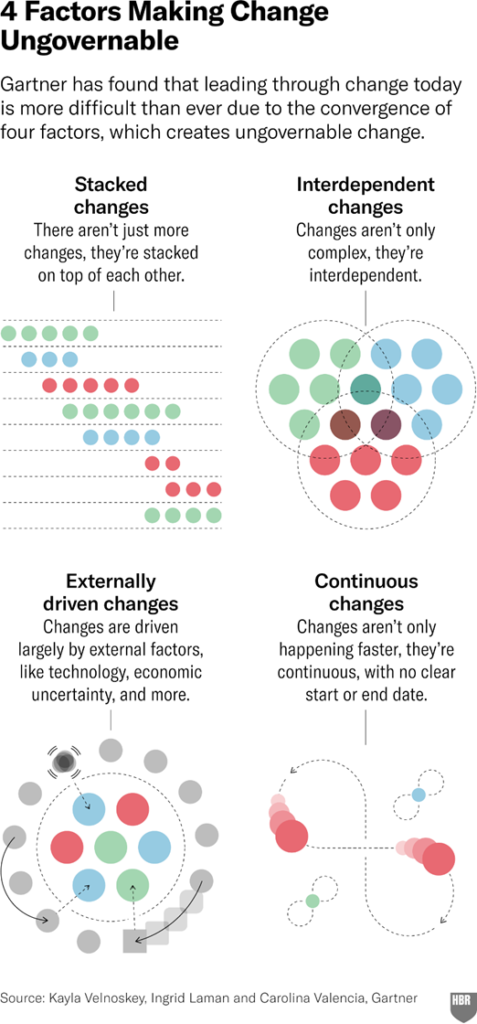
The Pace of Change Has Accelerated, and It’s a Bumpy Ride
From a talent perspective, the pace of change inside organizations has clearly accelerated. Roles are evolving quickly as leaders step into unfamiliar responsibilities with shorter runways and higher expectations. There is an amazing amount of pressure to “get it right”.
But this acceleration isn’t uniform. Some parts of the organization are absorbing change quickly, while others lag behind—not because of resistance, but capacity. In some cases, strategy moves quickly, but the support structures haven’t been updated. In other situations, new mandates arrive before teams have stabilized from the previous shift.
This imbalance creates friction. Leaders are not only navigating change itself, but also the misalignment between how quickly different parts of the system can respond.
Talent Challenges Are No Longer Isolated Moments
Historically, talent decisions followed a relatively predictable sequence: hire someone, invest in developing them, and plan for succession over time. Today, those lines are blurred. Recruiting, leadership development, and workforce sustainability are happening simultaneously, and they’re often at odds with one another. Decisions in one area are creating unintended consequences elsewhere.
A “quick hire” made to relieve immediate pressure on one team can introduce operational or cultural strain on another team. A leadership change can expose underlying fragility in groups that have been holding it together quietly. Retention issues can reveal gaps in succession that were never fully addressed.
Talent issues are no longer isolated moments. They’ve become overlapping conditions that leaders must navigate very carefully.
The Hidden Risk Is Fragmentation
Despite this shift, many organizations still structure talent decisions in silos with separate conversations for hiring, leadership, and employee wellbeing. In a slower, more predictable environment, that approach was manageable.
In today’s context, fragmentation has become an underlying threat. Leaders are asked to make decisions without full visibility into downstream impacts and HR teams are stretched trying to reconcile competing priorities. Organizations move quickly in one area, only to create pressure somewhere else.
What we’ve observed is that high performing organizations aren’t necessarily doing more; they are simply connecting the dots much sooner.
What We’re Seeing Across Humanis Advisory Group
Across Humanis Advisory Group, our work spans executive search, professional recruitment, coaching, leadership development, and HR advisory. This vantage point provides a unique window into how talent decisions interact inside organizations.
We see leadership transitions create opportunities to either stabilize or strain a workforce. We see hiring decisions shape leadership capacity long after the role is filled. And through coaching and advisory work, we often uncover patterns that extend far beyond a single role or team.
What stands out isn’t any single trend, it’s the consistency of the pattern.
Organizations that connect leadership, hiring, and workforce strategy early tend to build stronger momentum and resilience over time. When internal groups operate in alignment, the organization is better equipped to absorb change.
Introducing Total Talent as a Leadership Lens
What’s beginning to emerge across many organizations isn’t another program or initiative. It’s a shift in how leaders view talent altogether.
A Total Talent lens starts with a simple recognition: hiring decisions, leadership capacity, and workforce sustainability are not separate conversations. They are part of the same system, constantly overlapping and influencing each other. Often these connections remain invisible until pressure builds and something begins to break.
Seen through this lens, talent challenges rarely appear as isolated events. They are signals of deeper intersections where decisions around hiring, leadership, and workforce stability collide.
Total Talent isn’t something to necessarily “implement.” It’s a perspective that helps leaders see connections earlier, anticipate ripple effects, and navigate complexity with greater coherence. In that sense, what’s emerging is not a new program, but a new way of looking at talent: as a connected system rather than a series of isolated decisions.
The Signals Leaders Should Pay Attention To
The talent scene will continue to shift. Roles will keep evolving and expectations will keep rising. Navigating ungovernable change is now part of modern leadership.
In this environment, the advantage isn’t in predicting every change. It’s in spotting the signals early: subtle misalignments, recurring pressure points, and moments when decisions clash in unexpected ways. These signals often show up long before the data does.
Leaders who notice them gain something invaluable: the ability to respond with intention rather than react out of urgency.
Organizations that begin seeing talent as a connected system will be far better positioned to navigate what comes next. For those willing to look closely, the signals are already there.